Grasshopper Course in Abu Dhabi: Professional Training Program
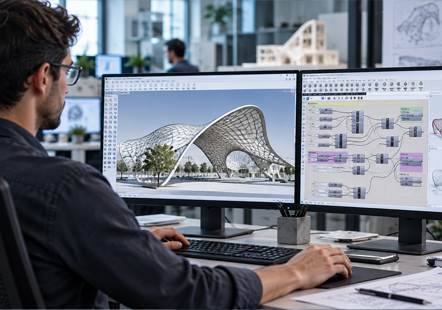
Some geometries are simply too complex, or too dependent on changing variables, to model by hand one surface at a time. Grasshopper is built to solve this. As a visual programming plugin built into Rhino, it lets designers define a shape through logic and relationships rather than fixed geometry, so changing one parameter, a curve’s radius, a panel’s spacing, a facade’s angle, updates the entire design automatically. Cadd International’s Grasshopper training in Abu Dhabi is built around this shift in thinking, from modeling a single static form to designing a system that can generate many valid forms.
The course starts with the Grasshopper interface, data structures, and basic parameter inputs before moving into building complete parametric definitions for curves, surfaces, and complex geometry. A working knowledge of Rhino is assumed going in, since Grasshopper runs as a plugin rather than standalone software, but no prior programming or scripting experience is needed, the visual, node-based interface is designed specifically to make algorithmic thinking accessible without writing code.
Why Are Grasshopper Skills Becoming Non-Negotiable in Design?
Architecture and design firms taking on ambitious, geometrically complex projects, curved facades, responsive structures, optimized panel systems, simply can’t produce that work efficiently through conventional modeling, which is exactly why Grasshopper has become a standard expectation on computational design teams across the region. Designers who understand parametric logic don’t just model faster, they can explore dozens of design variations in the time it would take to manually build one, which makes them genuinely more valuable on projects where the client wants options, not just a single answer. It’s also a skill that compounds, since a strong Grasshopper definition becomes reusable across future projects, turning what used to be one-off modeling work into a toolkit a designer can build on for years. As building geometry across the region keeps pushing toward more ambitious, less standard forms, the gap between conventional modelers and algorithmic designers keeps widening.
Programme Highlights
The Grasshopper interface and node-based visual programming basics
Parameter inputs, sets, and data structure management
Building points, curves, and surfaces algorithmically
Constructing complete parametric definitions for real design problems
Automating repetitive modeling tasks through logic-driven workflows
Guided practice with practicing computational designers
Begin Your Training with Cadd International
Cadd International’s Grasshopper programme is taught by designers who use parametric workflows on real architectural and design projects, not just tutorial exercises. Training centers across Abu Dhabi and the UAE make the course accessible wherever you’re based.
Courses that we provide
Our expertise has made us the leader in our field and developing our knowledge and skills is what keeps us there.
As we are striving through the world of designing, the importance of computer-aided designing in the field of mechanical engineering seems to be inevitable.
Many people within the industry believe Building Information Modelling, also known as BIM, to be a tool or software used in the design.
What our Students Says?
Beyond the qualification, it’s the passion and the right training with proper guidelines which determines your success in your career.
Posted on Google
Guru
2026-09-16
Trustindex verifies that the original source of the review is Google.
I recently completed my BIM Structural classes at CADD International, and I had a very good experience here. The staff are very friendly, supportive, and approachable. Our trainer, Sankar, has excellent knowledge of Revit and explained the concepts clearly with practical guidance.
Posted on Google
boobalan mbm
2026-09-16
Trustindex verifies that the original source of the review is Google.
Thank you Shankar bro, Made a nice training.
Posted on Google
Karthikeyan D
2026-09-16
Trustindex verifies that the original source of the review is Google.
"One of the best Revit Structure courses! Ravi Shankar provides clear, step-by-step guidance on structural drafting, rebar scheduling, and BIM workflows. Great teaching style and very practical course content."
Posted on Google
Leb X Kevin
2026-09-12
Trustindex verifies that the original source of the review is Google.
Easy to learn thanks to good guidance from surya. Always assisted with any questions i had and helped greatly with the exercises.
Posted on Google
Dinesh Chandran
2026-09-06
Trustindex verifies that the original source of the review is Google.
I had a very good experience with the SOLIDWORKS training. The sessions were well structured, practical, and easy to understand. Trainer Amit explained each concept clearly and patiently, with useful practical examples and guidance throughout the course. His approach made it easier to understand the software and apply the concepts in real-world design work. I would definitely recommend this training to anyone looking to improve their SOLIDWORKS skills.
Posted on Google
Umaima Khan
2026-09-05
Trustindex verifies that the original source of the review is Google.
Miss soorya was really amazing. She taught with alot of patience and went over complicated topics.
Posted on Google
Afnan
2026-09-03
Trustindex verifies that the original source of the review is Google.
I've completed my training with Surya, it was a useful sessions.
Posted on Google
Mcavidad albano
2026-08-31
Trustindex verifies that the original source of the review is Google.
I had an excellent learning experience at CADD International Abu Dhabi. Special thanks to ms. Surya for his outstanding AutoCAD training. She explained concepts clearly, provided practical examples, and was always willing to help with doubts. His guidance greatly improved my AutoCAD skills and confidence. I highly recommend CADD International.
Posted on Google
Sebastian Mestra
2026-08-31
Trustindex verifies that the original source of the review is Google.
The classes have been great. The lessons are clear and easy to understand, and the instructor explains the topics very well. I have learned a lot from these classes, and they have been very helpful and beneficial for improving my knowledge and skills. I really appreciate the learning experience and would definitely recommend these classes.
Posted on Google
Aisya Sofiya
2026-08-26
Trustindex verifies that the original source of the review is Google.
I had a very positive experience with the training center for BIM For Architect. The trainers , Sir Ravi Sankar were knowledgeable, supportive, and explained the topics clearly with practical examples. The training was well-organized, and the staff were professional and helpful throughout the process. Overall, I’m satisfied with the service and would recommend the training center to others who are looking to improve their skills.
No. Grasshopper uses a visual, node-based interface instead of written code, so the course teaches algorithmic thinking without requiring any prior programming background.
Complex, data-driven geometries, such as curved facades or repeating panel systems, that would be extremely time-consuming to model by hand, since changing one parameter updates the entire design automatically.
Computational design, parametric design, and digital design roles at architecture and design firms working on geometrically ambitious or facade-heavy projects.
What our Clients Says?
We are very proud of the feedback that we have recieved for the quality of our Training.
VX STUDIO
VX STUDIO is a multi-disciplinary, concept to completion Architectural design practice, specialising in developer-led, value-driven design
DRY DOCKS WORLD
Our Focus About Us Facility Careers Media Drydocks World wins Shipyard & Ship Repair Facility of the Year at The Maritime Standard Awards.
KPS
KPS is a technology-led, design-focused interior contractor that brings commercial spaces to life by tapping into trends, innovations, and resources because we believe every space holds the opportunit
General Electric
The General Electric Company (GE) is an American multinational company. For more than 130 years, GE has invented the future of industry.
Al Arabia
Established in 1971, Al Arabia for Electro Mechanical L.L.C. caters to the growing demand of the UAE’s continuously transforming landscape.
Emirates Global Aluminium
Emirates Global Aluminium is the world’s largest ‘premium aluminium’ producer and the biggest industrial company in the United Arab Emirates outside oil and gas.
Arif & Bintoak
A team of experienced consulting architects and engineers who have been delivering quality services for over 40 years.
KHANSAHEB
Khansaheb was founded in 1935 and has developed into the highly respected company that it is today – a company renowned for professionalism, integrity, high quality and reliable delivery.
JOTUN
Jotun is one of the world’s leading paints and coatings manufacturers, combining the best quality with constant innovation and creativity. For almost a century, we have protected all types of property